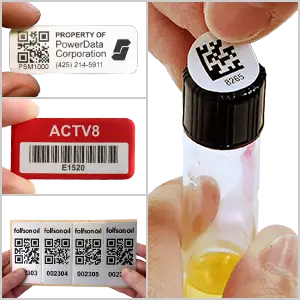
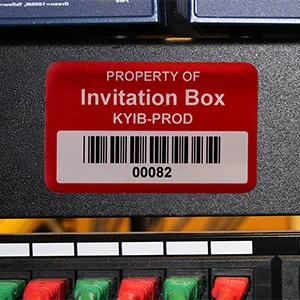
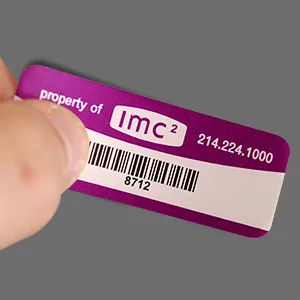
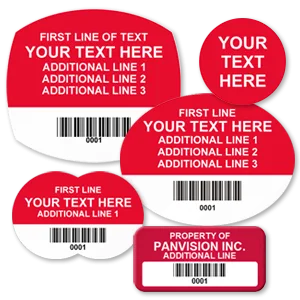
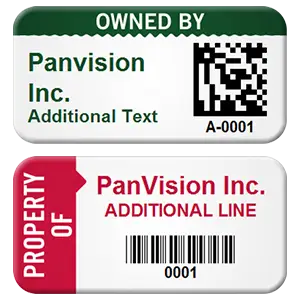
We number your asset tags consecutively. You give us a beginning number and the quantity. Starting with your initial number, we just create the batch with sequential numbers. Of course, if you have a letter prefix or letter suffix, we will print these letter codes – but the actual numbers will march along consecutively.
The other minor exception concerns customers that want a non-linear set of numbers. This is possible (and happens all of the time!). Just send us your XLS file or other data file and we will upload this automatically into your order.
Asset labels from our range are engineered to bond permanently across a wide variety of surfaces, though adhesion depends on correct surface preparation and matching the right adhesive to your environment. The most common causes of failure are application to wet, dirty, or cold surfaces, thick tags on compound curves, and heavily textured substrates. Each scenario has a specific solution, so contact us or browse our industrial asset labels range for specialist adhesive options.
Yes, we will. That makes it easy to reorder your tags!
Replacing an asset tag is easiest when you order a small surplus supply upfront, so replacements are always on hand. We keep your past order history on file for fast, accurate reorders, with minimums starting at just 50 to 100 tags depending on material. Laser-printable label sheets are also a great on-demand option for urgent replacements.
Asset tag packaging formats vary by material: metal tags come on strips, EconoGuard labels on sheets, and PermaGuard, TheftGuard and StealGuard labels on rolls. Custom packaging is available in most cases, including splitting odd and even numbers into separate packs. Contact us to discuss your requirements or browse our custom asset labels for more options.
Custom asset tag templates can be built specifically for your organisation by our in-house programming team. Your bespoke layout is saved under your personal My Designs area for easy reordering at any time. Contact us to discuss your requirements and explore our custom asset label design service.
AlumiGuard asset tags adhere exceptionally well to Dell computers and most major brands, as metal and high-performance plastic chassis are ideal bonding surfaces. Apply the tag to an inconspicuous area of the frame and allow 48 hours for the adhesive to fully cure. For more options, browse our full range of computer asset labels.
Asset tag numbering is applied consecutively by default. Provide your starting number and total quantity, and we generate the full sequential batch, including any letter prefixes or suffixes. For non-sequential or randomised numbers, simply send us your .XLS or data file and we upload it directly into your order, following ISO 55000 asset management guidelines.
Asset tag adhesive comes pre-mounted to the back of every label, no separate purchase needed. Simply peel the liner, press firmly onto the surface, and allow 48 hours to cure for a near-permanent bond. Our AlumiGuard asset tags use 3M adhesive, with alternative formulations available for specialist surfaces.
Logo quality directly affects the finished appearance of your custom asset tags, so always use the highest resolution version available. Lines must be at least 2pt wide at final print size, fine detail under 0.01 inches will fill in, and all text should be removed from around the logo for the cleanest result. If you are unsure whether your artwork meets our print specifications, contact our design team before placing your order.
Asset labels for cell phones adhere very well to the smooth flat surfaces of modern smartphones and PDAs. Beyond tracking, a visible label significantly increases the chance of a lost device being returned to its owner. Clean the rear surface before applying and allow the adhesive to cure for 48 hours for best results.
Asset tags are durable identification labels used to track and manage physical items throughout their lifecycle, and Property ID tag is simply one of many synonymous terms for the same product. Other common names include asset labels, property identification labels, asset management labels, and property tags, all referring to the same function. For a full overview, visit our dedicated page on what is an asset tag.
Custom asset label design support is available directly from our sales team at 888-343-3729, or you can email our design team for a prompt response. We guide you through every stage of the design process and welcome your suggestions for improving our asset tag design programme.
Custom asset label design is straightforward even without an existing logo, as we offer hundreds of ready-made graphics to choose from online. Adding a logo gives your labels a professional appearance and makes them significantly harder to counterfeit. Browse our custom asset tag options to get started.
Adhesive asset tags for fabric surfaces like computer backpacks will come off too easily, so we recommend our AlumiGuard asset tags with holes punched into each end instead of adhesive. Simply rivet the tags directly through the nylon strapping or backpack material for a permanent, tamper-evident fix. Rivets are inexpensive and available at most large hardware stores.
High-temperature asset tags for industrial equipment require a material rated well beyond your operating range, and our AlumiGuard asset tags can withstand short-term peak exposures of up to 1,000F, making 300F well within their performance envelope. We strongly recommend requesting a sample pack and testing under your actual operating conditions before committing to a full order. Browse our industrial asset labels range for a full comparison of material options.
This may vary by project. Here are some of the fields that customers might gather as they assemble a list of assets to tag:
1. Serial number or other unique number for asset
2. Asset description
3. Cost of the asset
4. Installation and upgrade costs for the asset
5. Date that the asset was purchased or obtained
6. Asset Class
7. Location for the asset
8. Owner of the asset (i.e. is it leased, which company owns it, etc.)
9. Size, weight, color of asset
10. Intellectual Property value or other security risks associated with the asset i.e. how critical is it to your security and business strategy to keep the asset tracked)
11. Depreciation method (straight line, double declining depreciation, etc.) and current asset value (net of depreciation and replacement value)
12. QA/QC and Maintenance requirements for the asset
Small top-up orders of asset tags are entirely possible, with minimums starting at just 50 to 100 tags depending on material. We recommend ordering a small surplus upfront to avoid delays when new equipment arrives. Laser-printable asset label sheets are also a flexible interim solution for printing individual tags in-house on demand.
Laser-printable asset label sheets are the fastest solution when you need replacement tags immediately, printing as professionally as pre-manufactured labels on any standard laser printer. One pack accommodates multiple label designs, giving you full flexibility at short notice. Keeping a supply on hand is best practice for any organisation subject to regular ISO 55001 compliant equipment audits.
Long alphanumeric sequences like ASB-20933-09 are fully supported across our custom numbered asset tags. We recommend Code 128 for dense alphanumeric strings, or a 2D Data Matrix code for sequences exceeding 200 characters, in line with GS1 barcode standards. Simply send your number list as an .XLS or .CSV file and we load it directly into your order.
Barcode scanners for asset tracking are compatible with almost any professionally manufactured asset label, but the most important factor is ensuring your scanner integrates with your chosen software. Key considerations include portability, budget (contact scanners start under $50, laser scanners run $200 to $800), scan range, and whether your team could use smartphone scanning instead, as most modern asset tracking software now supports mobile devices. Refer to GS1 scanner compatibility resources for further guidance.
QR code and 2D barcode asset tags work best with iPhone scanning apps, offering superior error-checking and reliable reads. Small 1D metal barcodes can be inconsistent on iPhone cameras due to reflective surfaces, so we recommend requesting samples to test before ordering. Contact us for guidance on the best barcode format for your mobile workflow.
Proper surface preparation is the most important step in ensuring your asset labels bond correctly. Clean the surface thoroughly, avoid touching the adhesive side as skin oils can reduce bond strength by up to 40%, and use a squeegee or roller to eliminate air pockets and prevent edge flagging. Full adhesive cure takes 48 to 72 hours, and our installation video walks you through the full process.